Share issuance
done right.A specialised tool to guide you from invitation to subscription.
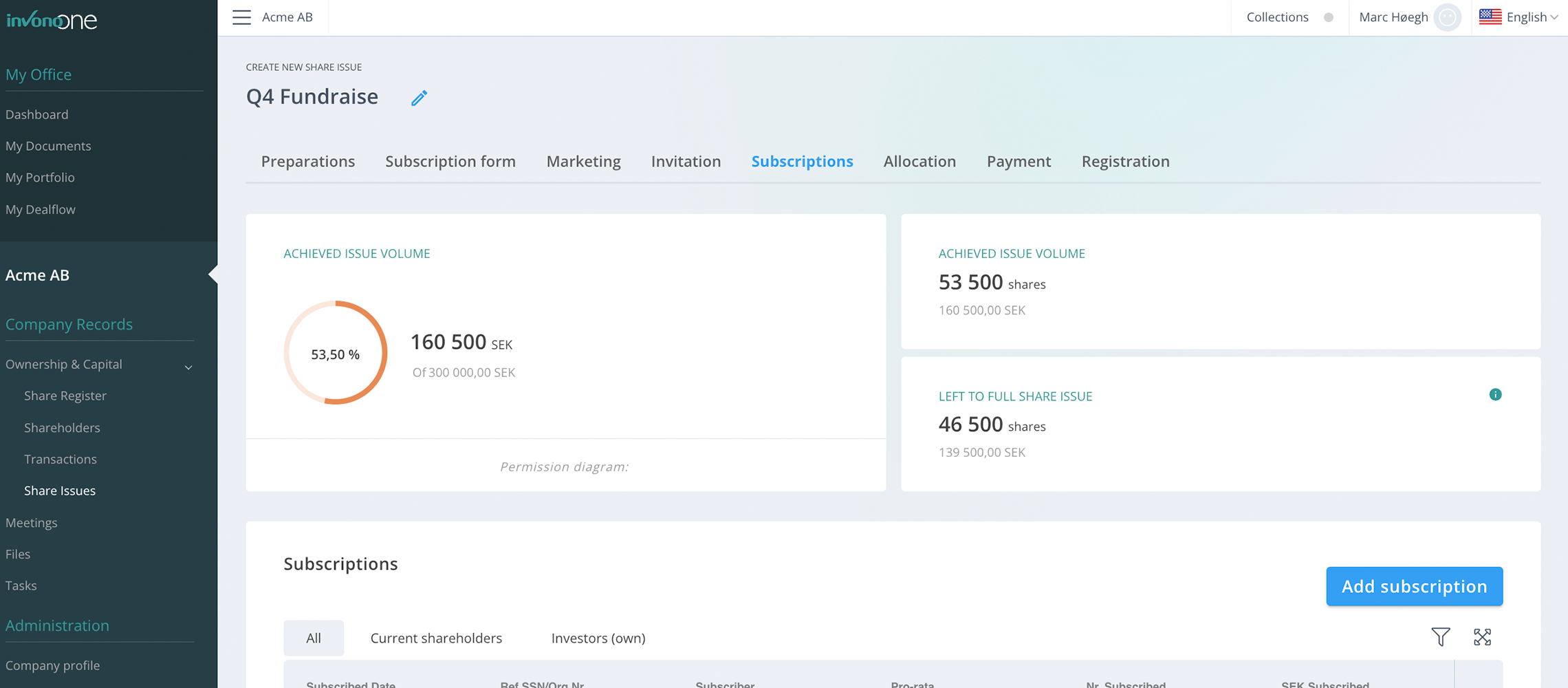
Already after 24 hours, 500 people had clicked through to our share offering. The new link feature is awesome.

Poyan Sandnell
Founder, Catch Me
I’ve carried out many share issues, but never without problems. This is a whole new world.

Peter Davin
Entrepreneur & Investor
Share issuance in unlisted companies
When carrying out a new issue, there are many things to keep track of so that the process will be efficient and correct. Before you start an issue, you must have made a formal decision at a board meeting and at a general meeting.
The general meeting must be quorum and the issuance decision must be within the framework of the current articles of association.
The problem
Once that's done, the hard work begins with convincing existing shareholders to continue to "support" the company's journey to success, while often also requiring finding and convincing new investors to "get on the train."
Both existing shareholders and new investors want to see a clear plan for value growth and repayment of invested capital, and the process of selling one's own company in an issue requires its own section.
However, in parallel with this work, you must also be able to show the investors that you are in control of the situation and that there is structure and order in the company. You must be "investment ready" at the same time as you must administer all the time-consuming steps in the issue process.
The solution
This is where Invono One comes in with its share issuance module. We help you check that the formalities are correct before the new issue and then we guide you through 8 steps in the issuance process where the time-consuming steps are automated and you get full control through the various steps.
If you then need us to help with the process, the valuation or how to find new investors and sell the issue to them, we will be happy to help with that as well.
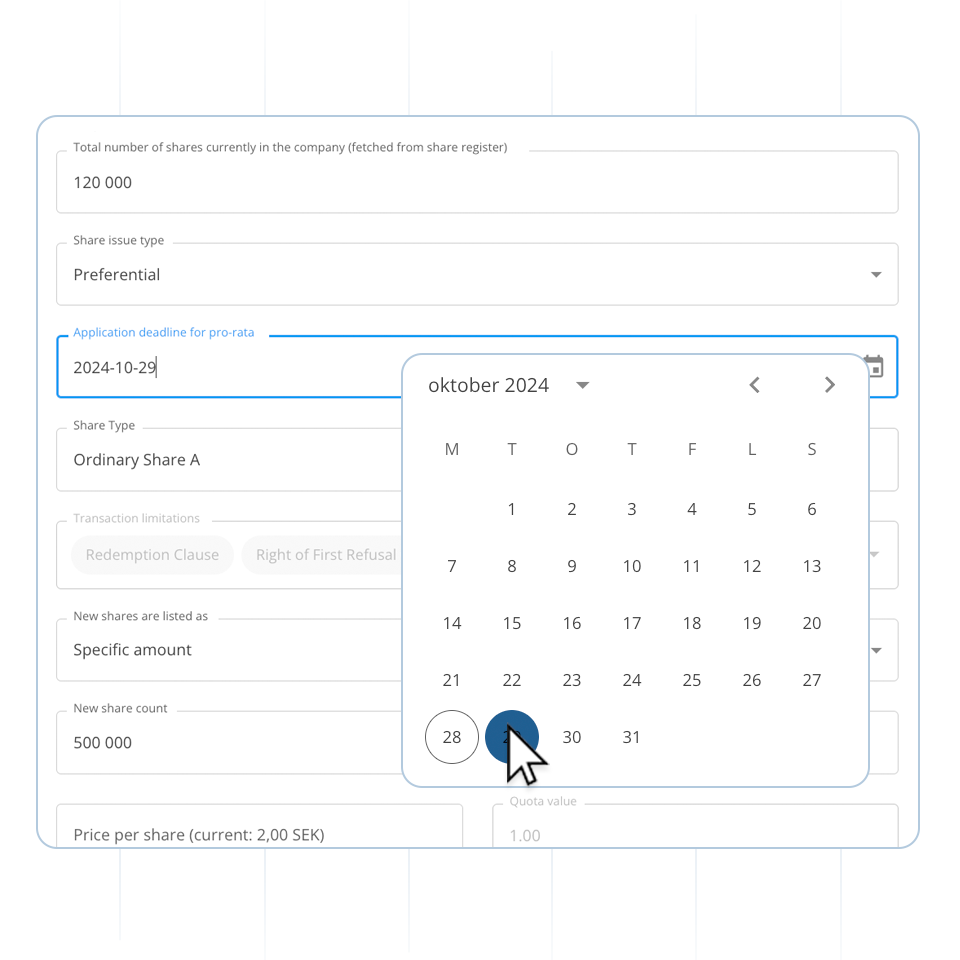
Specify how many shares, at what cost, by which date, and what should happen to any exceeding amount. Also, how allocation is decided, when payment is expected etc.
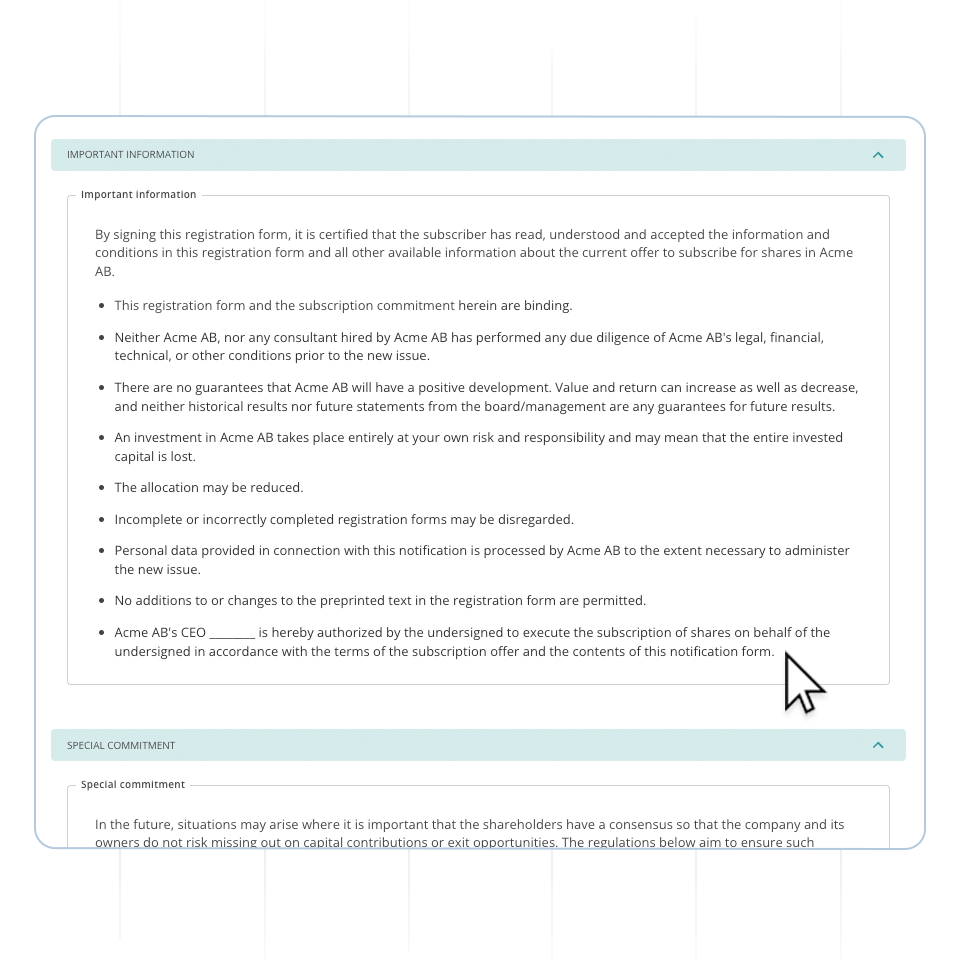
We provide suggested standard texts with basic information. You can edit them to suit your needs, for instance, providing additional required legal information.
Existing shareholders receive an electronic registration form that is pre-filled - they only need to add the number of shares they express an interest in subscribing to. New investors fill in how they intend to subscribe and information about the subscriber.
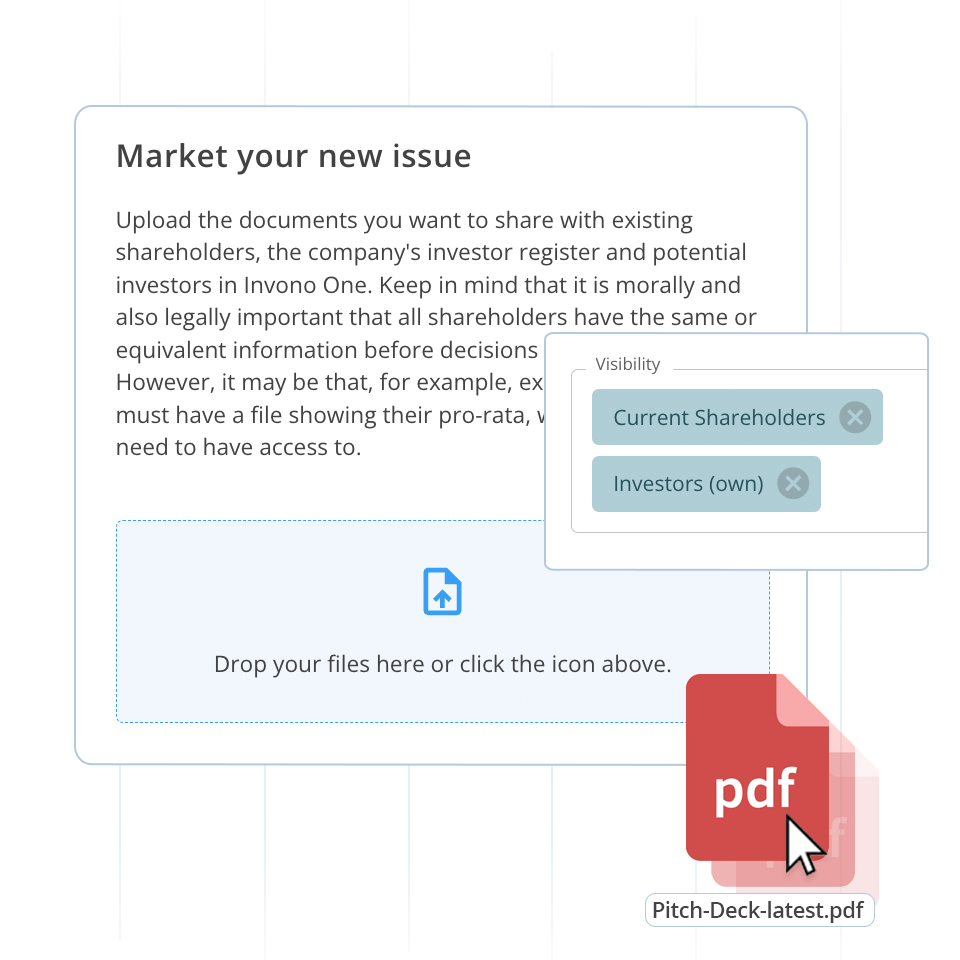
Upload marketing materials that describe why they should invest in your business. This can usually be a pitch deck along with other relevant information about your business.
Here you configure, among other things, whether you want to display a diagram that shows how things are going in the issue.
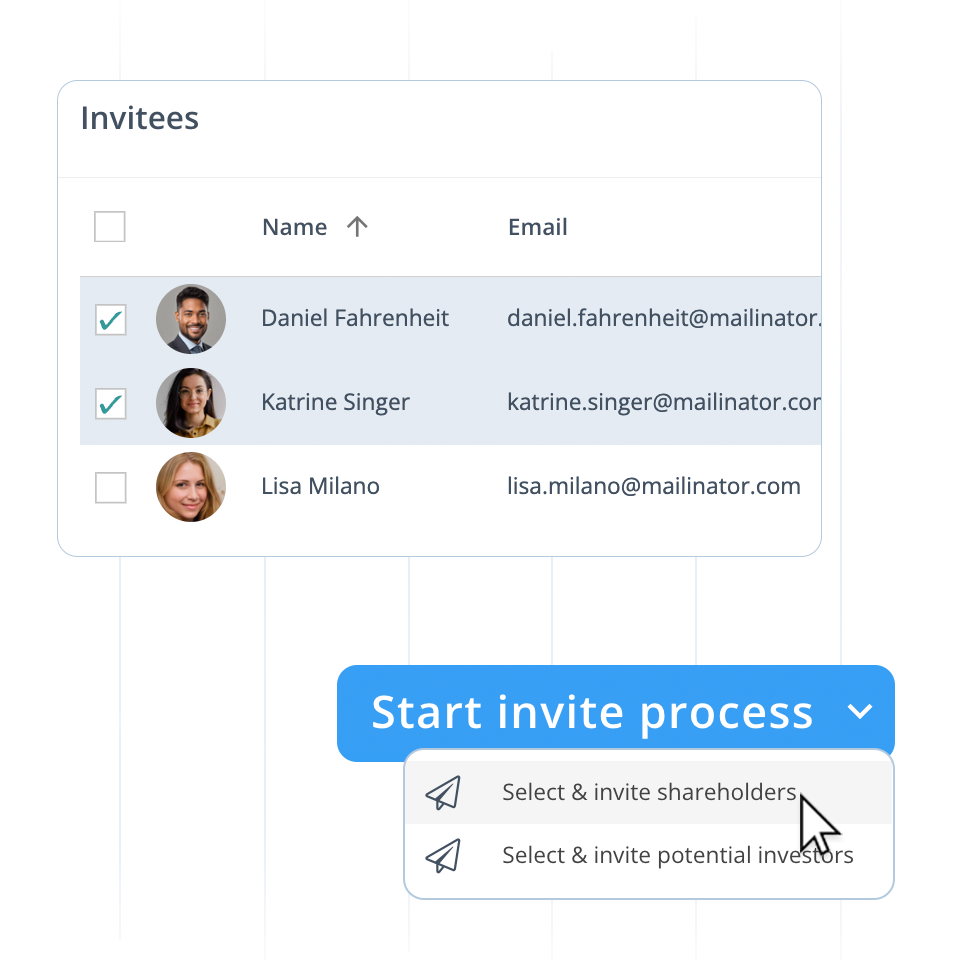
Choose who should be able to participate in the issue. You can choose between existing shareholders, investors that you have in your own register or you can let our platform find potential investors for you, based on whether they have shown interest in your company directly or indirectly.
We recommend all companies to advertise for new investors in the platform. It costs nothing extra!

When you invite the shareholders, you get access to a simple CRM system so that you can process your investors until a decision is made. You get a good overview of who has subscribed for shares and how much has been subscribed in total.
It only takes minutes for the person who is to subscribe for shares to fill in the information and e-sign via the phone.

Decide how you want to allocate shares based on the application forms submitted. If it is an existing shareholder, their pro-rata is pre-filled and it is therefore easy to determine allocation.
In case of oversubscription, you get to decide how many shares you will ultimately offer each shareholder. We have support to help with these calculations.

When you close or partially close the issue, the share book is automatically updated and settlement notes with allocated shares and share sequences are sent out with information about payment.
When the shareholder has paid, the receipts are sent out with the push of a button.
You have full control over the wording of the e-mails that are sent out with invoices and receipts.
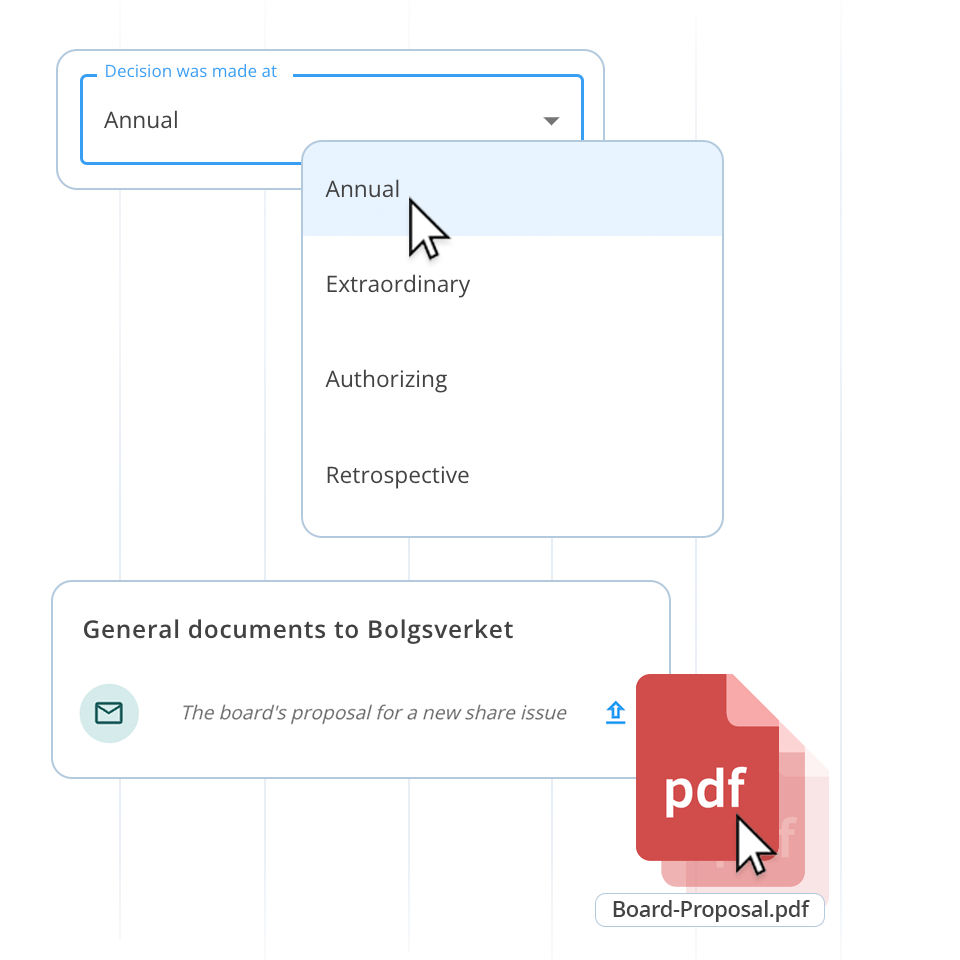
Finalise the process by gathering and uploading the required documentation containing details about your share issue.
This is also where you collect and upload any confirmations, such as receipts for payment to the Registration Office etc. This means that you have all documentation surrounding the entire process neatly stored in one place for future reference.
Questions about share issuance
How many shareholders may subscribe for shares in a new issue?
This describes what applies to a coupon company (a private company that is not a reconciliation company).
A maximum of 200 new shareholders may be allocated shares in a new share issue. This means that if you have 100 shareholders already and all subscribe for shares in the new issue, you can have 300 who subscribe for shares in the issue (100 old shareholders and 200 new shareholders).
This is based on the Dissemination Prohibition, which prohibits a private company from disseminating its issue offer to more than 200 people, unless they have asked in advance to take part in such offers.
How many shareholders can a private company have?
A private company may have any number of shareholders. Historically, it has been an advantage to become a reconciliation company and let Euroclear manage one's share book, as it has been difficult to manage this in paper form or Excel sheets when the owner list has become too large.
With the digital share register in Invono One and share deposits for the shareholders, this is no longer a problem. Many companies today choose to manage their share register themselves, even if they have many shareholders, as it gives them better control and contact with their shareholders.
What do I do if there is an error in an share issue?
We're here to help.
Most mistakes made in an share issue can be corrected, but it often requires deep knowledge and experience to get the right solution, which we have at Invono.
Do not hesitate to get in touch for professional consultation, both before starting a share issue, but also if you have questions during the process.
How to succeed with share issues
To succeed with a share issue, you need thorough preparation, good timing, and clear communication with current and potential investors. Automating the process and securing all formalities in advance reduces risks. A structured issue process with a lead investor, ownership communication, and realistic issue size increases the likelihood of successful capital raising.
Share issues are often crucial to a company’s growth and survival. With Invono One, the entire share issue process can be automated and quality-assured – from digital share registers and data rooms to investor dialogue – making the process faster, safer, and more professional.
How to Succeed with Share Issues – Strategic and Legal Guide
Share issues are among the most vital yet complex aspects of a growth company’s financing strategy. Success is not just about raising capital – it’s about strengthening the company structure, building investor trust, and ensuring future viability. Below is how to maximize your chances of a successful issue.
1. Automate the Process to Minimize Risk
By using a digital share issue platform like Invono One, the process is legally compliant and efficient from start to finish. Invono assists with:
Proper handling of subscription lists
Digital distribution and collection of investment documentation
Automatic updates to the share register
This minimizes the risk of formal errors, which can be difficult or impossible to correct later.
2. Prepare All Formalities in Advance
Before launching the issue, ensure:
Board and general meeting resolutions are in place
Share register is updated
Shareholder agreements and articles of association align with the issue
Clear definition of issue type: rights issue, directed issue, or convertible loan
With Invono One, these documents are securely managed, version-controlled, and shared via data rooms for due diligence.
3. Choose the Right Strategy
As a private limited company, you may have an unlimited number of shareholders as long as the company remains unlisted. Avoid early listing due to:
High costs
Pressure for quarterly reporting
Reduced flexibility in decision-making
You may offer shares to an unlimited number of existing owners, but only 200 new investors. Plan accordingly.
4. Use a Lead Investor and Guarantee Strategy
Ensure your issue is partly subscribed when opened. For example:
A 4 MSEK issue
2 MSEK guaranteed by existing shareholders
Communicate plans for both 2 MSEK and 4 MSEK outcomes
This reduces risk for new investors and increases credibility.
5. Appoint a Capital Raising Officer on the Board
A dedicated board member responsible for capital raising:
Acts as or recruits a lead investor
Can invoice 6–10% of raised capital (no VAT)
Frees up founders and CEO to focus on operations
6. Build Trust Through Ownership Communication
Don't only communicate when capital is needed. Regular updates build loyalty. Assign someone to:
Own investor communication
Send monthly or quarterly reports
Share both good and bad news factually
Informed shareholders are more likely to stay long-term.
7. Use Interim Structures When Valuation or Capital Needs Are Unclear
If you’re unsure of valuation or capital needs:
Use a convertible note or simple loan agreement
Convert the loan to shares in a future issue
This gives time to evaluate without halting growth.
8. Be Realistic About Burn Rate
If capital is draining faster than expected:
Cut costs quickly and decisively
Focus on critical operations
Communicate openly with owners
Maintaining a healthy burn rate is key to avoiding insolvency and retaining trust.
Invono One – A Tool for Successful Share Issues
Invono One supports companies in growth and transaction phases with:
Complete digital share issue handling
Automated share register updates
Formal document sharing in secure data rooms
Structured investor communication
Option for anonymous investor interaction
Invono One offers a modern, secure, and professional environment for raising capital the right way – and on the right terms.
How to Present Your Company to Investors
A company should be presented clearly, quickly, and professionally. Start with a 30-second pitch, followed by a 5-minute presentation, and finally a concise, visual pitch deck of 10–12 slides. The focus should be on execution capability, credibility of the business idea, market potential, and realistic funding needs.
Investor attention is limited. A clear and efficient presentation increases the chances of securing the next meeting. With Invono One, companies can compile, structure, and share investment information in a way that supports the full journey from pitch to due diligence – saving time and building trust.
Presenting Your Business – From First Impression to Investment
Impressing investors today means communicating potential, risk, and credibility fast and effectively. Long, detailed investment memorandums have largely been replaced by compact, visual presentations. Here’s how to prepare an impactful investor pitch.
1. The Modern Investor Wants Speed and Clarity
In the past, 40–50 page investment memorandums (IMs) were standard. Today’s investors prefer:
A 10–12 slide pitch deck
Visual and concise communication
A scalable, credible, and ideally disruptive business idea
A timeline with clear value milestones within 5–7 years
Over-optimistic “hockey stick” forecasts may turn investors away – but a flat growth plan won't attract anyone either. Balance is key.
2. Think of Funding as a Staircase
Your capital strategy should progress in steps. Each new funding round should be linked to:
A tangible milestone (e.g., launch, revenue, certification)
A justified valuation increase
A plan with built-in flexibility for timing or market shifts
Excel models are always wrong – show that you understand this and build for resilience.
3. Build a Tiered Pitch Process
Professional investors expect a tiered presentation process:
30 seconds: Elevator pitch (film yourself until it’s natural)
5 minutes: Short business overview
10–12 slides: Visually compelling pitch deck
Upon interest: Additional materials and data room access
4. How Professional Investors Think
Most investors base decisions on six core factors:
Team execution capability
Do they have relevant experience? Are they likable, driven, and trustworthy?
Credibility of the business idea
Are projections realistic? Is the timeline viable?
Technology edge
Is there innovation? Are references available to validate it?
Market potential
Is there a real problem? Is the market willing to pay for the solution? Is it big?
Competition
Are there competitors in the market? How is your offering differentiated?
Financeability
Is the business likely to secure sufficient capital under current market conditions?
5. Common Mistakes to Avoid
Overvaluation too early:
May lead to future down rounds and loss of investor trust.
Too much information:
Founders love details – investors want relevance.
Overly complex slides:
Don’t make your pitch harder than it needs to be. Keep it simple.
6. AI-Generated Due Diligence – A Second Opinion
Together with Advera, Invono has created an AI-powered due diligence report that:
Pulls public data via APIs from authorities and databases
Compiles external insights on the company
Provides investors with a
neutral second opinion
beyond what the company presents
This strengthens transparency and reinforces trust.
7. Invono One – For Smart, Transparent Company Presentation
Invono One is not only for handling share issues – it also helps you:
Build and share digital pitch decks
Create secure data rooms
for selected investors
Track document downloads and interest levels
Provide investors with a full picture
of your business
The result: a more professional, efficient capital raise – with you in full control of the process.
How do you show respect to your shareholders?
Respecting your shareholders means acting with transparency, fairness, and accessibility. It requires keeping the share register updated, ensuring that shareholders receive timely and accurate information, and structuring share issues so existing owners can protect their holdings. Invono One enables this through digital share accounts, automated communication, and tools that safeguard both companies and investors.
A company that treats its shareholders with respect builds long-term trust and loyalty. Invono One makes it easy to manage large ownership groups, create structure in share issues, and ensure equal treatment of all shareholders. The platform strengthens the relationship between the company and its owners while reducing legal and administrative risks.
Showing Respect to Shareholders – A Guide to Good Ownership Practices
Maintaining a professional and respectful relationship with shareholders is fundamental to long-term corporate success. It is not only about sharing information – it is about giving shareholders transparency, influence, and security. Below we explain how this can be achieved in practice, supported by Invono One.
1. An Updated and Accurate Share Register – The Foundation of Respect
In an unlisted private company, the board of directors is responsible for maintaining the share register. It must be updated:
When shares are transferred
When shares are allocated in a share issue
When any other ownership-related changes occur
A common misconception is that companies should wait to update the share register until a share issue has been registered with the Swedish Companies Registration Office (Bolagsverket). This is incorrect. The register must be updated as soon as the board becomes aware of a change.
Invono One automates this process, ensuring that all shareholders always see correct information in real time.
2. Digital Share Accounts – Transparency and Accessibility
With Invono One, every shareholder receives a personal digital share account through CapTable+, where they can view:
Their shareholdings and transaction history
Share issues they have participated in
Upcoming investment opportunities
Company documents and ownership data
Invitations to general meetings and new share issues
Contact details that can be updated centrally
This creates a transparent and user-friendly ownership experience without unnecessary intermediaries.
3. Clear and Reliable Communication
Respect for shareholders also means ensuring that communication is professional and structured. With Invono One, companies can:
Send reports, newsletters, and invitations directly to shareholders
Ensure information always reaches the correct person – even if email addresses change
Track interactions, such as who has opened share issue documentation
This improves shareholder relations and minimizes misunderstandings.
4. Respectful Share Issue Processes – Protect Existing Owners
The fundamental principle in a share issue is that existing shareholders should have the opportunity to protect their ownership from dilution. Invono One supports several fair structures, including:
Rights issues with pro-rata subscription
Over-allocation to new investors
Models where existing shareholders share over-allocation
The entire process is digital and transparent, ensuring every shareholder receives individualized information and fair treatment.
5. Protecting Investor Privacy
Invono One allows investors to follow target companies anonymously until they actively choose to participate in a share issue. This means:
No unwanted contact or spam
Full control over personal exposure
Secure handling of personal data
This is particularly important in the unlisted market, where long-term trust is essential.
6. Clarity Around the 200-Shareholder Rule
There is often confusion about how many shareholders a private company may have:
A private “coupon company” may have an unlimited number of shareholders
The socalled spread restriction means that a share issue may not be offered to more than 200 new investors – unless they have previously registered interest
Invono One handles this automatically by allowing investors to actively opt in to receive investment opportunities.
7. Investor Protection Through a Strong Articles of Association
Shareholders should always review a company’s articles of association, as this document shows:
How voting rights are structured
What level of influence minority owners have
How easy or difficult it is to exercise shareholder rights
A company that designs its articles to facilitate shareholder participation demonstrates respect and long-term thinking.
What is a share issue module?
A share issue module is a digital tool that helps companies plan, execute, and document a share issue – from the initial decision to final payment. In Invono One, the module guides the user step by step through the entire process, ensures the correct documentation is used depending on how the decision is made, manages subscription forms, allocations, and automatic updates to the share register, and simplifies marketing to both existing and new investors.
Share issues are typically carried out infrequently, which makes the process uncertain and risky if not handled correctly. The Invono One share issue module reduces the need for external consultants, streamlines every step, and provides legal security. The result is saved time, lower costs, and higher quality – for both the company and its investors.
The Share Issue Module in Invono One – Full Control of the Process
Conducting a share issue is a complex process involving legal, administrative, and practical steps. Invono One has therefore developed a dedicated share issue module that enables companies to manage the entire process internally – correctly, efficiently, and without unnecessary costs.
1. Why Is a Share Issue Module Needed?
Most companies conduct share issues so rarely that it is difficult to remember all the details:
What formal decisions are required?
Which documents must be prepared?
How is correct allocation ensured?
What if investors want to pay by set-off or with assets in kind?
How do investors receive information?
Invono One’s share issue module answers these questions directly within the system – without the need to contact lawyers, auditors, or advisors at every stage.
2. Step-by-Step – How the Share Issue Module Works
Preparations
Enter all key data: issue size, valuation, and terms
Select decision method: annual meeting, extraordinary meeting, board authorization, or post-approval
The system identifies and lists the required documentation
Subscription Form
Create subscription forms in both Swedish and English
Language is automatically adapted to each user
Pre-filled templates that are fully editable
Marketing
Upload pitch materials, videos, financial documents, and other supporting files
Set permissions for who can access what
Invitations
Invite investors in four steps:
Existing shareholders
Your own followers via dealflow
New investors who have shown interest in similar companies
External contacts through sharing functions
Subscription List
See in real time who has subscribed
Add manual applications when needed
Assist investors through the process
Allocation
Automatic pro-rata calculations
Support for oversubscription and directed issues
Allocation decisions, automatic share register updates, and distribution of allotment notes
Payment
Mark payments as they arrive
Send receipts with a single click
Registration and History
All documents and actions are stored
Easy access to complete historical records
3. Smart Functions – More Than Just Legal Compliance
Support for set-off and contributions in kind:
The system identifies when additional documentation is required
Role-based access:
Different permissions for CFOs, board members, or administrators
Full traceability:
Every action is logged
Export options:
Data can be exported to Excel or PDF
4. Cost Savings and Efficiency
By digitizing and automating the process, Invono One users have:
Saved SEK 1,000–1,500 per shareholder
Reduced the need for external consultants by up to 80%
Significantly simplified work for management and the board
Companies can handle the entire process themselves – from decision to payment – with full legal confidence.
5. Find New Investors – Free of Charge
Through the share issue module, companies can also advertise their share issues within Invono One’s investor network at no cost:
Investors remain anonymous until they choose to participate
Companies can include direct contact details
Announcements appear under [My Portfolio] and [My Dealflow]
This increases exposure and subscription levels without paid advertising.
6. Security and Confidence for All Parties
The share issue module creates value for everyone involved:
For the board:
Proper documentation and secure decision-making
For administration:
Simplified handling of subscriptions and payments
For shareholders:
Transparency and easy access to documents and receipts
For investors:
Professional presentation and clear information
Invono One makes share issues easier – and, most importantly, safer.
What do you need to know about a share issue?
A share issue (nyemission) is when a company issues new shares to raise capital. The process is regulated by Swedish company law and requires careful handling of legal and financial formalities. The capital raised increases both the share capital (based on the nominal value of each share) and the share premium reserve, typically the unrestricted share premium, allowing the company to freely use the funds for development or growth.
If a share issue is handled incorrectly, the decision may be invalid, or the company may face shareholder disputes or legal consequences. Invono One offers a share issue module that automates and secures the entire process – from preparing legal documents to issuing new shares – helping companies save both time and money during capital raising.
Share Issues in Sweden – Legal Rules, Formalities, and Best Practices
Raising capital through a new share issue is a critical part of many companies’ growth strategies. However, it is also a legally regulated process that must be executed with precision. Below is a detailed overview of everything you need to know to ensure your share issue is compliant, effective, and successful.
What is a Share Issue (Nyemission)?
A share issue means issuing new shares in the company to bring in capital, usually for:
Growth and expansion
Product development
Strengthening the company’s balance sheet
The capital received is allocated to:
Share capital – number of new shares × nominal (quota) value
Share premium reserve – the amount paid above the nominal value
Most commonly, the unrestricted share premium reserve is used, allowing free use of the capital for business development.
Formal Requirements for Share Issues
Decision Methods
A share issue can be resolved in one of four ways:
At the Annual General Meeting (AGM)
At an Extraordinary General Meeting (EGM)
By the board with prior authorization
from the AGM
(must be registered with the Swedish Companies Registration Office – Bolagsverket)
By the board with subsequent shareholder approval
Each method requires specific formal steps and documentation. Methods 2 and 3 require a board report on material events to ensure no insider advantage.
Voting Requirements:
Rights issue (existing shareholders are given the right to subscribe): requires 50% majority
Directed issue (new shareholders only): requires a two-thirds majority (66.67%)
Key Legal Protections in the Swedish Companies Act
The Swedish Companies Act includes essential shareholder protection rules:
Equal treatment of shareholders (Chapter 7, Section 47 ABL)
Equal rights for shares of the same class (Chapter 1, Section 1 ABL)
No improper advantage – decisions must not give unfair benefits to any shareholder
The board must act in the interest of all shareholders, not just some
Failing to follow these principles may lead to the decision being declared invalid or challenged in court.
The 200-Shareholder Limit (Spread Restriction)
According to Chapter 1, Section 7 ABL, private companies may not offer shares to the public. In practice, this means:
A share issue can involve no more than 200 new shareholders
This must be carefully considered when planning the marketing or distribution of share offers.
Insider Information and Equal Disclosure
Before conducting a share issue, all shareholders must have the same information and access. Therefore, the board may need to prepare:
A report on significant events
An assessment of the company's current financial position
This prevents any party from benefiting from insider information during the subscription period.
Payment by Set-Off (Kvittning) or Contribution in Kind (Apport)
Payment in a share issue may be made via:
Set-off (converting existing debt to shares)
Contribution in kind (e.g., tangible assets instead of cash)
These require specific formal documentation, including:
Description of the payment method
Auditor's verification by an authorized auditor
A company planning to issue shares under these conditions should ensure it has a licensed auditor in place.
Invono One – Automating the Share Issue Process
Invono One provides a comprehensive digital solution that streamlines every step of the share issue process:
Automation of all legal formalities and templates
Digital distribution and collection of subscription documentation
Instant updates to the share register
Secure sharing of documents via data rooms
Result: Peace of mind that everything is done correctly – and substantial cost savings. Some companies have saved over SEK 250,000 by using Invono One instead of external consultants for manual processing.
We can help you with issuing shares in your unlisted company.