Unlisted.
Ownership. Meetings. Files. All in one place.
I can't believe we've been managing everything in Excel until now.

Per Geber
CEO at DKLBC AB
Our share register auto-updated after we issued shares. Gamechanger.

Anders Lindell
CEO at Myloc AB
I now feel in complete control when I'm issuing shares.

Lars Birging
CEO at ZIGRID AB
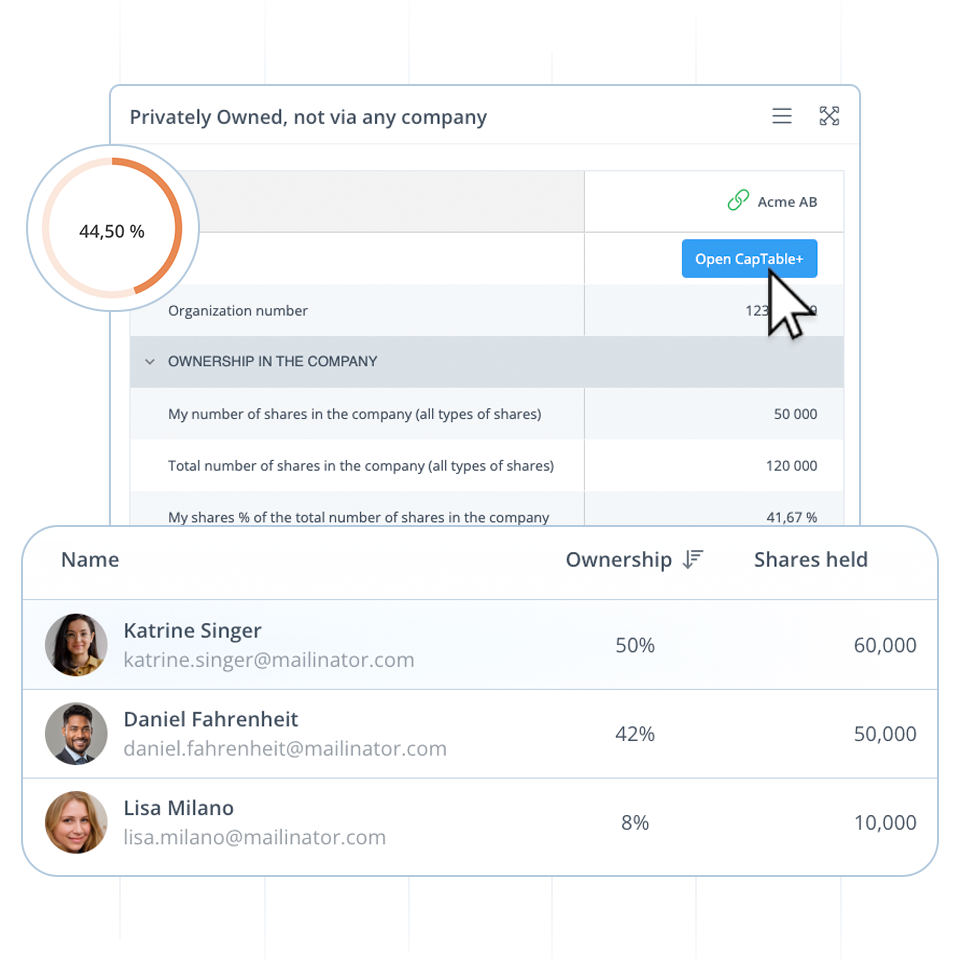
Our digital share register solution is built with a dualistic mindset, taking both company admins and shareholders into account. Portfolio management and depository service via CapTable+. Digital handling of share issuance and much more.
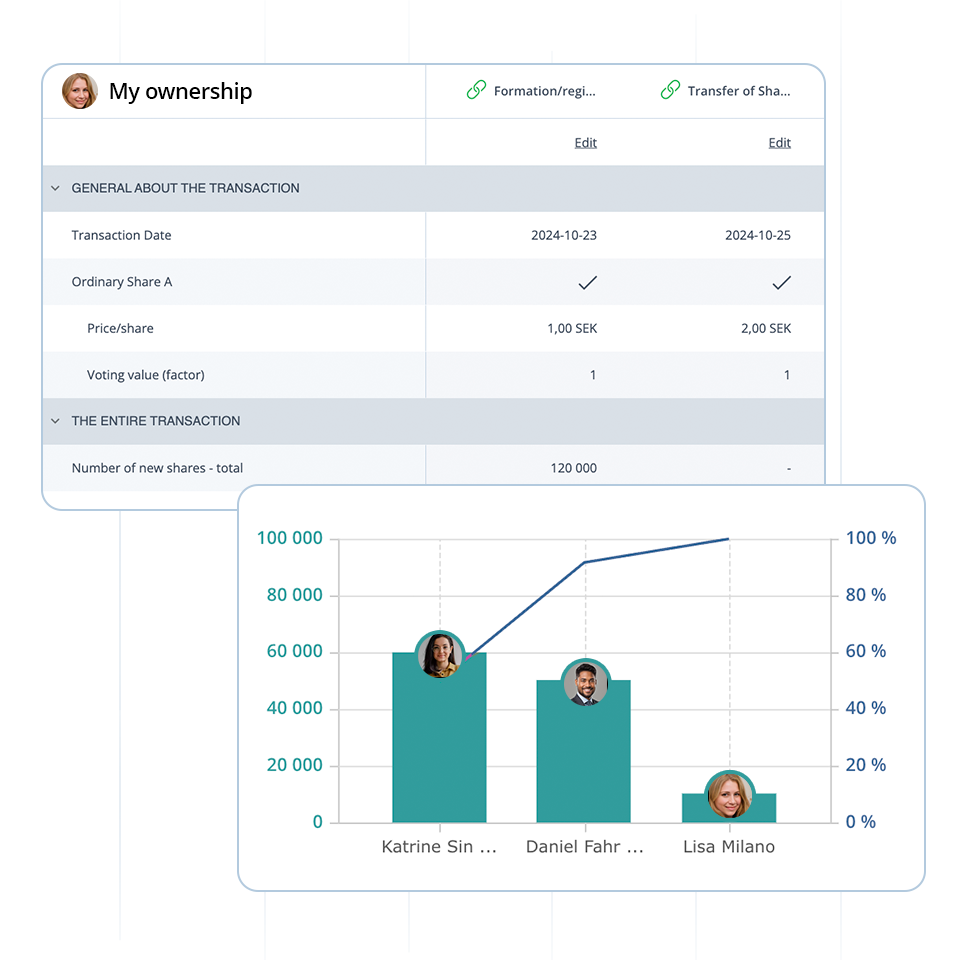
Respect the shareholders' investment in your company by giving them access to accurate ownership information in real time.

Experience the benefits of the otherwise time-consuming, complex and expensive job of issuing shares in your unlisted company by following a structured workflow streamlined towards addressing the legal and practical concerns associated with this process.

We provide three different meeting tools. Something for every need and for every wallet.

Standard Meetings
Suitable for all maturity levels and wallets. Invite and sign digitally. Perfect for uploading historical logs so that team keeps track of the history.

Smart Meetings
Everything digitised - right down to private notes on each agenda item for the participants - nothing is left out.

AGM
Digital invitation and registration. Digital attendance control and voting at the meeting. Automatic voter register.
Corporate governance FAQ
How to work with capital raising?
Raising capital is essential for growing companies, especially early-stage ones. In challenging economic times, investors expect more – clear strategies, reduced risk, and transparent communication.
Invono One streamlines the capital raising process – from investor dialogue to fully automated share issues – making it easier to attract funding.
Raising capital – structure, endurance, and transparency
Most startups rely on external funding to grow. In pre-seed or seed stages, angel investors are key. The risk is high, but so is the return potential.
However, fundraising is not about "selling a dream" – it's about building trust, showing discipline, and running a professional process.
A changed investment climate post-2023
The post-COVID downturn and economic headwinds in 2023 hit hard. Over 10,500 companies went bankrupt in 2024 in Sweden alone. Angels and VCs now prefer later-stage investments with less risk.
This shift forces startups to reduce perceived risk for investors and demonstrate financial maturity and resilience.
Ten effective strategies for capital raising
Keep existing shareholders engaged
Clear, regular updates build trust.
Activate your board in investor relations
Leverage board experience to engage investors.
Cut your burn rate
Bold cuts show you understand the seriousness.
Run smaller bridge rounds
Easier to close, less valuation risk.
Secure guaranteed share issues
Get commitments upfront.
Use simple convertible loans
Flexible early-stage funding without setting valuation.
Offer sweat equity
Get help from people willing to work for future value.
Shift to a revenue-first mindset
Show how you’ll make money – even small wins matter.
Polish your investor presentation
Be ready with solid data, forecasts, and KPIs.
Use Invono One for execution
Automate share issues, track communications, sign documents digitally.
How Invono One supports capital raising
Invono One helps startups attract capital by offering the structure and tools investors expect.
Key benefits:
Digital shareholder register
CapTable+ view for investors
Automated issuance workflows
E-signatures for legal compliance
Investor communications with tracking
Investors trust companies with structure – Invono One helps deliver it.
Summary – It’s all about endurance
Endurance is the startup’s best weapon. Not every idea breaks through fast – but those who persist, adapt, and communicate well survive.
In a world where capital is harder to find, startups must:
Govern professionally
Communicate clearly
Raise creatively
Invono One helps you do all three – and increases your odds of funding success.
How are General Meetings managed?
The general meeting is the shareholders’ main forum of power. This is where owners influence the company’s governance, appoint the board, and make decisions on capital and legal structure.
Law, control, and strategy converge here. Critical decisions on emissions, the board, and articles of association require informed and active shareholders.
The general meeting – cornerstone of corporate governance
In a limited company, the general meeting is the highest decision-making body. According to the Swedish Companies Act (ABL 2005:551), this is where shareholders formally exercise their rights. In private companies, no authority monitors compliance with shareholder interests – it’s up to the shareholders themselves to act if something goes wrong.
Key functions of the AGM
At the annual general meeting, shareholders decide on:
Approval of the annual accounts
Discharge of liability for the CEO and board
Dividend decisions
Election of board members
New share issues
Amendments to the articles of association
Through attendance, voting, or proxy, shareholders directly influence these outcomes.
Board and CEO responsibility – driven by the owners
The board works on behalf of the shareholders. If it fails to protect their interests, it must be replaced. Each board member is individually responsible for prioritizing shareholder interests. Claiming to be overruled by a strong chair or CEO is no excuse – deviations should be reported, ideally to a nomination committee formed by the largest owners.
You get what you pay for. A professional board member costs approx. 72,000 SEK/year (2,000 SEK/hour × 36 hours). Compensation may be paid in cash or equity – but proper VAT handling is essential.
Share issues – protecting your stake
The meeting determines how new capital is raised:
Rights issue
– existing shareholders have pre-emption rights (requires simple majority: 50%)
Directed issue
– new investors are brought in (requires qualified majority: 66.7%)
For investors, it's critical to assess whether the company respects pre-emption rights – frequent directed issues may signal weak shareholder protection.
Share classes and voting rights
Shares of the same class must carry equal voting rights.
The max ratio between classes is 10:1 (e.g., Class A = 10 votes, Class B = 1 vote).
Dividends are usually equal, but
preference shares
may have priority – often used when shareholders lend money to the company.
Extraordinary meetings and digital participation
Shareholders holding at least 10% of the votes can request an extraordinary meeting.
Meetings may be fully digital or hybrid, if allowed by the articles.
Shareholders unable to attend can appoint a proxy via e-signature.
It’s surprising how few shareholders use their power at meetings – despite this being their strongest governance tool.
Gold bar analogy – the value you’re guarding
Think of a company worth 100 MSEK as 200 gold bars at 500,000 SEK each. Who would you trust to guard and grow that value? That’s the decision you make at the general meeting when electing the board.
Invono One – manage general meetings professionally
Invono One provides end-to-end support for managing general meetings:
Digital invitations and proxy handling
Structured resolution and liability discharge tracking
Version control of the articles of association
Integrated with board portals, share registers, and nomination committees
Invono One enhances transparency, reduces manual errors, and ensures formal compliance – essential for companies with growing shareholder bases.
How to find new investors
Finding new investors requires a combination of networking, digital visibility, and structured documentation. It’s about making a professional impression, having updated investment materials, and actively reaching out to relevant contacts through business networks, industry events, or digital platforms.
Attracting the right investors can be crucial for a company’s growth and long-term strategy. By using the right tools, such as Invono One, you can ensure all documentation, communication, and investment information is accessible and professionally structured – increasing the chances of successful fundraising.
How to Find New Investors – Legal and Strategic Overview
Attracting investors to a company is a strategic process that requires preparation, insight, and structure. It's not just about accessing capital, but about building long-term relationships that can contribute to business development through expertise, networks, and credibility.
1. Identify the Right Type of Investor
The first step is determining what kind of investor is appropriate for the current stage of the company:
Business angels: Suitable in early stages, often contribute both capital and expertise.
Venture capital firms (VCs): Typically invest in companies with proven business models and strong growth potential.
Private equity firms (PEs): Relevant in later growth stages or succession planning.
Public investors: For example through crowdfunding or listing on growth markets.
Understanding the investor’s goals and criteria is essential for positioning your offer correctly.
2. Prepare Professional Investment Materials
A structured and professional company presentation is essential in the investor process. It should include:
A pitch deck with business idea, market, team, financials, and growth strategy
Share register and ownership structure
Annual reports and financial statements
Legally relevant documents (e.g., shareholder agreements)
In Invono One, these documents can be compiled in a data room, simplifying due diligence and leaving a professional impression on potential investors.
3. Network in the Right Forums
Building relationships is often key to finding the right investor. Effective channels include:
Industry events and investor forums
Accelerators and incubators
LinkedIn and professional networks
Events hosted by banks, audit firms, or advisors
With Invono One, companies can document and follow up on investor contacts and maintain structured communication – increasing the chances of successful negotiations.
4. Use Digital Platforms and Investor Networks
There is a growing number of digital platforms where companies can present themselves to investors, such as:
Deal flow tools
Crowdfunding platforms
Specialized investor networks
Having visibility in the right places with the right message is critical – especially for companies in a growth phase seeking capital to take the next step.
5. Ensure Legal and Structural Transparency
Investors expect clear documentation and transparency. It is essential that the company:
Maintains an updated share register
Has shareholder agreements and articles of association in place
Has complied with formalities under company law and best practices
With Invono One, a company's legal structure can remain up to date and easily accessible, which simplifies both due diligence and investor relations.
Invono One – A Tool for Attracting and Managing Investors
Invono One is specifically designed for companies in growth or transaction phases. The platform enables:
A real-time digital share register and ownership structure
Easy access to data rooms and documentation
Structured communication with investors
Secure handling of formalities related to share issues
By using Invono One, a company positions itself as professional, transparent, and investment-ready – crucial in the competition for capital.
How to write a good Shareholders’ Directive
The shareholders’ directive is the owners’ voice in the company – it defines the strategic direction and frames expectations for the board and CEO. It should be concise, no longer than one A4 page, and reviewed annually.
Clarity and commitment: An effective directive aligns ownership, board, and management, reduces risk of misinterpretation, and strengthens governance quality.
The Shareholders’ Directive – a critical document
The shareholders’ directive (ägardirektiv) is where owners express what they want from the company. While not legally binding like a shareholder agreement, it provides strategic guidance with strong authority. It tells the board and CEO what the owners expect in terms of performance and direction.
Why is it so important?
Minimizes misalignment between owners, board, and management
Helps ensure the company stays aligned with the owners’ long-term vision
Provides continuity across leadership transitions
Think of it as a compass – it says where the company should go, not necessarily how to get there. That part is up to the board and the CEO, but always within the directive’s boundaries.
Key principles when drafting a shareholders’ directive
1. Keep it short, clear, and concrete
A good directive fits on one page. Avoid vague wording and instead use concrete goals, KPIs, and parameters.
2. Update it annually during the AGM
The directive should reflect the current state of the market, company maturity, and ownership goals. It should be signed digitally by the CEO, the board, and major shareholders to ensure commitment.
3. Focus on strategic direction, not operational control
The directive should set the priorities – e.g., "profitable growth with minimum 10% EBITDA" – without micromanaging how strategies are executed.
Example structure for a shareholders’ directive
SHAREHOLDERS’ DIRECTIVE – COMPANY AB (updated 2025-06-01)
Strategic focus
The company shall prioritize profitable growth. A minimum EBITDA margin of 10% is mandatory. Growth is welcomed but not at the expense of profitability.
Profit-sharing incentive
20% of defined “surplus profit” may be distributed as a bonus, provided turnover increased by at least 3% compared to the previous year.
KPI-based criteria
a) Turnover increased > 3% b) EBITDA > 10% c) Bonus = 20% of [turnover × (EBITDA% – 10%)]
Example
Turnover = 120 MSEK, EBITDA = 14% → surplus = 4.8 MSEK → 20% = 960 TSEK bonus + social fees.
Bonus distribution
20% to the board
20% to the CEO
20% to management
40% to staff
Quality and compliance
The company must be certified and compliant with ISO 9001, 18001, and 27001.
Ethical conduct
Employees may not accept gifts or entertainment from customers/suppliers.
CEO expense approval
All CEO expenses must be signed off by the chairman.
Leadership recruitment
All executive hires must be approved by the chairman, who also joins final interviews.
Nomination committee
The three largest owners form the nomination committee and propose a new board and directive 60 days before the AGM. The updated directive is ratified alongside the board vote.
“Rat on the rope” – accountability in governance
There’s a clear chain of accountability in a limited company:
The CEO runs operations and hires managers. If mistakes are made, responsibility lies here.
The board ensures oversight and strategic direction. If they fail to act, responsibility shifts to them.
The owners appoint the board. Choosing the wrong people or failing to give clear directives means the owners are accountable.
A clear shareholders’ directive ensures the correct distribution of responsibility and minimizes governance failure.
Invono One – digital management of shareholder directives
With Invono One, companies can manage their shareholders’ directives digitally and securely:
E-signing with audit trail
Version control of directives
Role-based access control (owners, board, CEO)
Integration with board portals and governance documentation
Using Invono One ensures legal and structural transparency while streamlining governance and long-term alignment with ownership goals.
How to attract capital from angel investors
Angel investing has changed. Post-COVID and amid a tough economic climate, angels are more cautious. Startups must reduce perceived risk, communicate effectively, and build long-term relationships.
Invono One provides a digital toolkit to streamline investor communication, share issues, and due diligence – increasing your odds of raising capital.
Angels invest with heart – but demand structure
Angel investors once filled the gap for early-stage startups. Today, they are more selective. The market shift means startups must show not only a great idea but also solid preparation, reasonable valuation, and trust-building behavior.
Three types of startups still raising funds:
Cashflow-positive companies seeking growth capital
More VC-compatible than angel targets.
Well-managed shareholder base with loyal supporters
Existing investors stepping up during downturns.
Community or trend-based investments
E.g., AI or sustainability – driven by hype, not always substance.
Eight tips for attracting angels
1. Price the round realistically
Don't scare off investors with inflated valuations.
2. Secure at least 50% of the round beforehand
Show social proof and lower perceived risk.
3. Offer at least 12 months of runway
Investors want their capital to last – not vanish in 3 months.
4. Activate a board member to lead fundraising
Free the founder to run the business.
5. Maintain ongoing communication with investors
Engagement matters between rounds too.
6. Leverage your shareholder base
Turn them into ambassadors, not just silent owners.
7. Perfect the 30/5/30 pitch
30 seconds: spark interest
5 minutes: create a hook
30 minutes: explain the endgame – “what’s in it for me?”
8. Make your company investment ready
Angels rely on external due diligence. Offer a credible third-party review.
Invono One – a trusted platform for angel engagement
Angel investors invest in people they trust – but they still expect professional-grade materials and process.
Invono One offers:
CapTable+: Investor dashboards
Digital share issues: Sign, pay, and track online
Communication tools: Keep investors updated
Investor tracking: Anonymous interest and deal registration
Due diligence readiness: Secure, transparent documentation
It’s not just a pitch – it’s a relationship
Angels invest when they feel a personal connection and professional security. That comes from:
Trust over time
Clear expectations
Realistic growth plans
Invono One helps you deliver all this – consistently, securely, and professionally.
Conclusion – Adapt to the new rules
Capital is still available – but the rules have changed. Succeeding means:
Lowering risk
Managing expectations
Playing the long game
With Invono One, you give yourself the best chance to meet those expectations – and find the right angel investor for your journey.
How do you lead a company to success?
Leadership is the key to success. True leaders inspire, delegate, and create a clear, positive environment. Managers control – leaders engage.
Structure, culture, and control drive results. Successful companies focus on clear goals (max 3 per employee), routine documentation, and a culture of shared victories and accountability.
Leading a company to success – through leadership, structure, and culture
Success in business doesn’t happen by accident. It requires consistent leadership, strategic structure, and a winning culture. Leadership is about inspiring people, not simply managing tasks.
1. Leadership vs Management – critical difference
Leader | Manager |
Inspires commitment | Assigns tasks |
Delegates authority | Gives instructions |
Leads by example | Drives performance through control |
Builds motivation and culture | Demands obedience |
Focuses on results | Focuses on compliance |
A CEO who leads creates engagement. One who only manages risks losing productivity and staff.
2. Clear goals – no more than three
No employee should be responsible for more than three main KPIs. More than that creates confusion. These goals must be:
Clearly measurable
Regularly reviewed
Linked to rewards
The board and CEO should define top-level KPIs together – see Shareholders’ Directive.
3. Breaking down barriers in growing companies
As companies grow, three problems often appear:
Responsibility silos: "That’s not my job"
Meeting overload: Too many meetings, too little outcome
Poor handovers: Departing staff don’t pass on key knowledge
Solution:
Promote a collaborative culture:
Reassign or exit those who resist.
Structure meetings:
Every meeting has a signed protocol (by convener, recorder, and one verifier)
At least one action point assigned per meeting
All protocols visible to CEO and managers
Document responsibilities weekly:
Staff document tasks using a standardized template
Managers e-sign
Documents stored in a shared cloud library
New hires get instant onboarding materials
4. Celebrate small wins – build a success culture
Recognizing achievements fosters motivation and cohesion. Ways to do this:
Cross-departmental goals
Company-wide bonus targets
Regular celebrations of success, big or small
A united culture wins more – together.
5. Control systems – with responsibility
Scalable companies need governance, not micromanagement. Use:
CEO instruction documents
Attestation policy (clear approval chains)
Continuous liquidity and compliance checks
Performance tracking for the CEO and leadership
CEO pay and expenses should be electronically signed off by the chair each year and monthly.
Invono One – your platform for success
With Invono One, companies can:
Use a digital
board portal
for meetings, protocols, and decisions
Store staff routines and workflows in a shared repository
E-sign policies, instructions, and meeting notes
Align KPI tracking with strategic documents
Ensure transparency between management, board, and shareholders
Invono One enables structure, responsibility, and transparency – essential traits for any company aiming for success.
What does it mean to serve on a board?
Being a board member is not an honorary position. It’s a professional, time-consuming responsibility. You represent the shareholders and are tasked with protecting and growing their investment.
The board governs – the CEO operates. The board appoints the CEO and oversees the company’s performance based on strategy, legality, financial control, and ethical standards.
The board’s role – accountability and long-term governance
Serving on a board means working on behalf of the owners to steer the company strategically, appoint the CEO, and ensure proper oversight. It's not about prestige – it's about competence, follow-up, and trust.
It’s not glamorous – it’s work
A board member is expected to:
Understand the business
Prepare and attend meetings (~6 per year)
Review materials and financials
Monitor legal and financial risk
Support the CEO – and replace them if necessary
Responsibility structure – from shareholders to staff
Role | Responsibility |
Shareholders | Appoint the board and issue directives |
Board | Appoint and oversee the CEO |
CEO | Operate and lead the company with the management team |
Shareholders’ directive – the board’s compass
The board must be guided by a clear and annually updated shareholders’ directive. It sets the strategic goals, financial benchmarks, and overall expectations.
CEO and leadership control
The board appoints the CEO and ensures performance. It does not micromanage operations. If board members are pulled into daily operations, it signals either the wrong CEO or the wrong chair.
Continuous oversight includes:
Liquidity monitoring
Ensuring tax compliance
Legal and ethical compliance
CEO compensation approval (annually) and expense attestation (monthly)
KPI-based reporting – stay focused
Good CEOs present focused reporting. Poor performers hide behind complexity. The board should monitor only three key KPIs, such as:
Revenue growth
EBITDA margin
Customer churn or lifetime value
Each can be broken down within departments, but the board must stay focused.
Compensation – pay for professionalism
You get what you pay for.
A professional board member should be paid at least 2,000 SEK/hour – about 72,000 SEK/year. The chair earns at least double. Compensation can be in:
Cash
Equity (with proper VAT handling)
Clear instructions ensure control
Two essential policies:
CEO Instruction – what the CEO is responsible for and how reporting should work
Attestation Policy – defines expense approval down the org chart
This ensures clarity and prevents grey areas of responsibility.
Invono One – board governance made professional
With Invono One, boards work more efficiently and securely:
Digital board portal (agendas, minutes, resolutions)
Integrated shareholder directive, share register, and governance docs
Auditor access to relevant documents
E-signing of CEO salary and expenses
Audit trail and control for discharge of liability
Invono One helps boards manage their mandate professionally and keeps them accountable – which is vital in investor-led companies.
What does investment readiness mean?
Investment readiness means a company is prepared to attract and secure external investments. It involves having a clear corporate structure, financials, governance, and legal compliance – so investors can efficiently assess risk and potential.
For investors, it provides confidence: An investment-ready company demonstrates professionalism, transparency, and operational control, simplifying due diligence and lowering the threshold for investment.
What is investment readiness and why is it important for both companies and investors?
Investment readiness refers to a state where a company is fully prepared – strategically, operationally, and legally – to engage with external investors. It's not just about seeking capital but about being structurally and mentally ready to receive it.
What does investment readiness mean for the company?
An investment-ready company has:
A clear, scalable business model and strategy
An accurate corporate structure
Formal governance documents like share registers, shareholder agreements, articles of association, board protocols
Complete financial data: budgets, forecasts, cash flow, historicals
Prepared investment materials: pitches, teasers, and a data room
Legal compliance: with local laws like the Companies Act, GDPR, etc.
Equally important is internal readiness – the company must understand what it means to bring in investors, including implications for ownership, valuation, and governance.
What does investment readiness mean for the investor?
For the investor, an investment-ready company offers:
Lower risk: good documentation reduces legal and operational uncertainties
Faster decisions: everything needed for evaluation is readily available
Clearer communication: goals, structure, and values are transparent
Efficient due diligence: especially critical for VC and PE investors managing multiple deals
Investors are not just looking for a great idea – they’re seeking a trustworthy partner to create long-term value.
Shared benefit – an aligned meeting point
When both company and investor meet at a shared baseline of clarity, professionalism, and readiness, the outcome is:
Faster funding rounds
Stronger valuations
Fewer legal hurdles
Greater mutual trust
The process becomes not only more efficient, but more valuable and fair to both sides.
The investment readiness process
Investment readiness is not a fixed state – it's an ongoing process:
Internal review: assessment of legal, financial, and strategic positioning
Formalization: updating legal documents and internal structures
Digitalization: organizing documentation in a professional data room
Pitch preparation: creating compelling investment materials
Dialogue training: preparing for investor meetings and expectations
Due diligence simulation: reviewing everything from an investor's perspective
This process is essential for growth companies aiming to attract venture capital, angel investors, or institutional funds.
Invono One – a platform for investment readiness
Invono One is a critical tool for companies that want to achieve and maintain investment readiness. It offers a digital infrastructure for corporate governance and documentation.
With Invono One, companies get:
A modern data room ready for due diligence
A legally compliant digital share register
A board portal for digital meetings, minutes, and decisions
Document control with audit logs
Ability to invite investors to view selected documents
Full control over ownership structures and incentive programs
Invono One not only accelerates capital raising but ensures companies stay investment ready over time – a crucial advantage for sustainable growth.
What makes a good Articles of Association?
A solid Articles of Association protects both company and shareholders. It reflects the ownership structure, governs share classes, voting rights, and meeting procedures – ensuring clarity and adaptability for future changes.
It must be modern, concise, and legally precise. A good Articles is digital-friendly, ownership-aware, and aligned with current shareholder dynamics.
The Articles of Association – legal cornerstone of ownership
The Articles of Association (bolagsordning) is a mandatory legal document that defines the internal rules of a Swedish limited company. Filed with the Swedish Companies Registration Office, it binds the company, board, and shareholders.
As private companies increasingly raise capital from a large number of investors, the need for a well-drafted, modernized Articles has never been greater.
As an investor, the Articles should be one of the first documents to review – it reveals the company’s governance maturity and shareholder approach.
Key elements of a well-drafted Articles of Association
1. Share capital, number of shares, share classes
Minimum and maximum capital
Number of shares (min and max)
Share classes (A, B, preference, etc.)
Voting rights (max 10:1 ratio allowed)
Dividend rights – usually equal, but preference shares may have priority
The Articles should also clearly define pre-emption rights during new issues – crucial for shareholder protection.
2. Board and auditor provisions
Number of directors and terms
Rules around board alternates
Auditor requirement
Having an auditor is essential for companies raising capital. Without one, investor confidence drops and transaction costs rise.
With Invono One, auditors can securely access protocols and governance materials, improving compliance and efficiency.
3. General meeting procedures
Recommended notice period: 14 days
Allow notice via email
Specify ability to hold digital or hybrid meetings
Digital AGMs create fairness in widely-held companies – and should be explicitly permitted in the Articles.
4. Annual general meeting agenda
Should include:
Presentation of the annual report
Discharge of board and CEO
Dividend/reserve decision
Election of board and auditor
Decisions on remuneration
Clear agendas help manage expectations and align governance processes.
5. Share transfer restrictions
May include:
Right of first refusal
Consent clauses
Redemption clauses
Our recommendation: Avoid such clauses in companies with >20 shareholders. They add administrative burden and hinder healthy ownership turnover. Instead, use shareholder agreements for key-person conditions.
Risks of an outdated Articles of Association
Failing to update the Articles can:
Delay fundraising
Deter investors
Create confusion about rights
Lead to disputes in ownership transitions
A good Articles should support – not limit – the company’s growth.
Invono One – digital governance done right
Invono One enables professional Articles management:
Secure versioning and audit trail
Alignment between Articles, board resolutions, and share register
Meeting invitation and digital voting tools
Auditor and committee access controls
Invono One transforms governance into a scalable, transparent process – especially critical when your shareholder base grows.
What does the Swedish Companies Act (2005:551) say?
Private companies may have unlimited shareholders. There is no limit of 200 owners – a common misconception. The 200-person rule applies only to new share offers to new investors.
No need to become a Euroclear-registered company. As long as the company handles its own share register (a "coupon company") and is not listed, Euroclear registration is not required.
Common misunderstandings clarified – the law on private companies
The Swedish Companies Act (ABL 2005:551) sets the framework for all limited companies in Sweden. For private, non-listed companies, there are some frequent misunderstandings:
1. How many shareholders can a private company have?
No upper limit.
There is no legal cap on the number of shareholders in a private company. The confusion often stems from the marketing/spread restriction in share offerings, not the number of existing shareholders.
Modern cloud platforms like Invono One now make it easy to manage hundreds or even thousands of shareholders – securely and legally.
2. Do we need to become a Euroclear company?
Only if you're listed.
Becoming an "avstämningsbolag" (Euroclear-registered company) is required only for:
Publicly listed companies
Private companies that choose to register with Euroclear
You are not required to register just because you have 200+ shareholders.
Benefits of staying private and self-managed:
Closer communication with shareholders
Lower costs
Full control over the shareholder registry
3. What is the 200-person share offering rule?
Max 200 new investors per share issue.
A private company cannot offer new shares to more than 200 new investors in one issue. However, you may exceed this number if recipients have pre-registered their interest.
Example: Almi can send to 1,000 recipients because they’ve all opted in.
4. When is a prospectus required?
Not for private placements to known investors.
The EU Prospectus Regulation only applies if:
The offering is public, or
The securities are to be traded on a regulated market
Thus, private placements to pre-qualified investors in a non-listed company are exempt from prospectus rules.
5. Why manage your own share register?
Better shareholder communication
Full ownership of data
Lower administrative costs
Easier invite management for AGMs and issues
Modern platforms remove the historical barriers of manual tracking and ensure full legal compliance.
How Invono One supports ABL-compliant ownership management
Invono One enables companies to manage their share registry and shareholder communication efficiently and legally.
Key features include:
Cloud-based, always-updated share ledger
CapTable+ to manage equity structure professionally
Secure shareholder login portal
E-signing for documents, AGMs, full powers, and share issues
Shareholder-managed contact updates
Email automation for meetings and reports
Best practices for maintaining shareholder trust
Send regular CEO letters
Host quarterly Q&A video sessions
Enable digital voting and AGM attendance
Offer transparent performance updates
Respected shareholders become long-term partners. Keep communication clear and ownership data reliable – with Invono One as your governance backbone.
Why is digital corporate governance necessary?
Efficiency and transparency: Digital corporate governance enables faster decision-making, better documentation, and clearer responsibilities. With digital tools, tracking decisions, meeting minutes, and reporting becomes significantly easier.
Compliance and security: Digital systems ensure that the company complies with current legislation such as the Swedish Companies Act and GDPR. This reduces human error and creates a secure, traceable, and legally correct governance system.
What is digital corporate governance and why is it necessary?
Digital corporate governance refers to the use of digital tools and platforms to support a company’s governance structure, processes, and regulatory compliance. As the business environment grows more complex and regulatory requirements become stricter, digital governance has evolved into a foundational element of modern corporate management – regardless of company size.
Legal and regulatory requirements
Swedish companies are legally required under the Swedish Companies Act to follow structured decision-making processes and to document items such as board meeting minutes, shareholder records, and annual general meetings. Manual or informal methods present legal and operational risks – especially during audits, due diligence, or legal disputes.
Digital corporate governance provides a centralized, traceable platform where all governance documentation is correct, up-to-date, and easily accessible. This is also vital for compliance with GDPR, where personal data must be handled in a controlled and auditable way – something hard to achieve with traditional workflows.
Efficiency in governance processes
Digital governance significantly reduces the time and effort required to organize, communicate, and follow up on board activities, shareholder meetings, and decision logs. It ensures that the right people access the right information at the right time – all in compliance with internal policies and external laws. This is especially critical in companies with multiple stakeholders or investors.
Automation features such as secure document distribution, e-signatures, document locking, and audit trails contribute to streamlined operations and reduced administrative burden.
Transparency, accountability, and control
Digital tools make it clear who did what, when, and why. This fosters a culture of transparency and accountability, building trust both internally and externally. Investors, auditors, and regulators gain clear insight into how the company is managed, thereby enhancing the company’s credibility and valuation.
How Invono One supports digital governance
Invono One is a specialized platform for digital corporate governance and equity management. It offers a complete ecosystem covering all critical governance functions:
The board portal includes access to meeting invitations, agendas, minutes, supporting documentation, and e-signatures – all traceable in one place.
Shareholder services and a digital shareholder register simplify administration and communication with stakeholders.
A secure data room supports due diligence, investments, and audits.
Automated logs and history provide full compliance and control.
The platform is designed to handle both early-stage startups and larger corporate groups. Since Invono One is tailored to Swedish regulations, it ensures legal certainty and administrative reliability.
Conclusion
Digital corporate governance is no longer optional – it's essential for running a company with legal integrity, operational efficiency, and professional transparency. Invono One provides an all-in-one solution that helps companies meet legal requirements, streamline governance, and build trust with stakeholders. By going digital, businesses reduce risk, improve control, and lay the foundation for sustainable growth.
Why should shareholders be kept informed?
Informed shareholders are engaged shareholders. Clear and consistent communication builds trust, increases the chance of reinvestment, and supports alignment in decision-making.
Invono One simplifies shareholder communication. With digital signing, delivery tracking, and centralized access to documents, shareholders get the information they need – while reducing the administrative burden on the company.
Keeping shareholders informed – essential for sound governance
A company’s success isn’t just about products or leadership – it also depends on how well its shareholders are informed and engaged. In growing companies with many investors, communication gaps can lead to legal risks, poor decisions, or loss of trust.
Reasons to keep shareholders informed:
To meet legal obligations – e.g. AGM notices (Companies Act Chapter 7)
To allow shareholders to make informed decisions – especially on share issues
To build long-term trust and loyalty
To prevent disputes and passive ownership
Risks of poor shareholder communication
AGM notices don’t reach the correct contacts
Shareholders miss key documents before voting
Rights issues are missed due to lack of notice
Misinformation spreads about the company’s value or direction
Keeping shareholders informed prevents confusion, disengagement, and legal complications.
Invono One – your platform for professional shareholder communication
Invono One enables secure, centralized, and transparent communication between companies and their shareholders.
Key features that support communication:
E-signing for notices, proxies, resolutions, and meeting minutes
Communication center with email delivery and open tracking
Access to documents via CapTable+ investor portal
Central archive for governance materials
Automated reminders for key events
Contact update sync across all portfolio companies
How to build shareholder trust through communication
Send a CEO update monthly or quarterly
Invite to quarterly Q&A video calls
Provide direct access to key documents and decisions
Show respect by giving full transparency into their investment
Communicating well with shareholders is a strategic advantage
Companies that communicate:
Clearly and consistently
With timely, relevant updates
And show they value their shareholders
…are more likely to retain investors and grow.
With Invono One, you turn communication into a strength – and build a base of informed, long-term shareholders.
Why is it important to keep shareholder information updated?
Keeping the shareholder register accurate is the board’s legal duty. But shareholders must report updated contact details themselves. If they fail to do so, they risk missing critical information like general meetings or share offerings.
Invono One syncs shareholder data automatically. One update by the shareholder reflects across all portfolio companies – saving time, avoiding errors, and maintaining trust.
Updated shareholder data – a legal and strategic necessity
According to the Swedish Companies Act (ABL 2005:551), Chapter 5, Section 7, the company’s board must:
“maintain the share register and make it available to everyone.”
That means the board is legally responsible for keeping the share register updated – but only if the shareholder has provided new information. Without this input, the board cannot be held accountable.
Risks of outdated shareholder data
Example:
A shareholder changes their email but doesn’t inform the companies. As a result:
Misses general meeting invites
Misses the chance to subscribe in a rights issue
Misses updates on share value or financial reports
This could lead to missed rights and financial losses – with no clear way to assign legal blame afterward.
How Invono One solves this – automation and visibility
Invono One is a secure, cloud-based platform for shareholder communication and registry management.
Key features:
CapTable+ dashboard: Shareholders log in to see all their portfolio holdings
Automatic data sync: An email update by the shareholder is pushed to all relevant companies (if using Invono One)
Communication center: Boards can track email deliveries and openings
E-signing tools: Simplify document and meeting participation
Full transparency: Shareholders always access their ownership data and history
Benefits for the company – less admin, more trust
By educating shareholders to update and manage their info via Invono One, companies:
Reduce back-and-forth for updates
Avoid missing contact info during meetings and share issues
Deliver better investor relations
Save time during audits and year-end reporting
Respecting your shareholders means making ownership easy
Professional companies simplify ownership administration for their shareholders. That includes:
Transparent documentation
Reliable communication
Direct access to personal ownership data
Automated updates
With Invono One, you build a stronger, smarter, and more trusted relationship with your shareholder base.
Who holds ultimate responsibility in a company?
The owners hold the ultimate responsibility. They set the direction through the appointment of the board and the issuance of a clear shareholders’ directive.
The board and CEO manage – but the owners lead. If the board fails, it is the owners’ duty to act. Otherwise, they risk losing control over their investment – symbolically, the gold bars.
Owners’ responsibility – the foundation of corporate governance
In a limited company, it may seem like the board or CEO holds the ultimate power. But in truth, it’s the owners who bear the highest responsibility. This is carried out through three essential steps:
Communicating intent – via a shareholders’ directive
Appointing a competent and engaged board
Following up and acting when needed
1. Shareholders’ directive – the owners’ tool
A well-written directive gives the board and CEO clear instructions about the company’s goals and direction. It should be concrete, measurable, and updated annually. When done right, it minimizes misunderstandings and strengthens accountability.
Long-term governance starts with clear intent.
The directive should be signed by the CEO, board, and major shareholders to establish commitment.
2. The board – the owners’ extended arm
It is the owners’ responsibility to ensure the board has the skills, motivation, and incentives to represent them effectively. They must:
Ensure the board understands and follows the directive
Appoint professionals with the right competence
Compensate them fairly – either through fees or future ownership
A qualified board member is worth around 2,000 SEK/hour. If not paid directly, equity-based incentives like options can align their interests with the company’s growth.
3. Accountability chain – “rat on the rope”
When things go wrong – who is to blame?
This chain of responsibility is clear:
The CEO runs operations. If failures happen repeatedly, the board must act.
The board oversees direction and risk. If they don’t act, the owners must intervene.
The owners appoint the board. If they’re passive or unclear, they are accountable.
Gold bar analogy
Thinking of the company’s value as gold bars makes the importance of governance tangible. Without active owners or a capable board, it’s like leaving gold unguarded – exposed and unmanaged.
Owners must guard their gold – by appointing the right board and setting clear expectations.
Invono One – a platform for responsible ownership
Invono One provides digital infrastructure that supports owners in fulfilling their responsibilities. With structured tools for governance and documentation, ownership becomes:
Traceable – Directives, decisions, and accountability are documented
Transparent – Clear communication of roles and responsibilities
Efficient – Annual updates and sign-offs done in minutes
Key features:
Digital signing of directives
Board portal with meetings and protocols
Ownership documentation (share register, agreements)
Nomination committee support
Secure document storage
Invono One ensures that no gold is left unguarded – it empowers owners to actively manage, protect, and grow their investment.

Our secure cloud storage solution with advanced metadata and built-in eSigning, authorization management and sharing will streamline work for everyone who needs quick access to correct information.
Add your shareholders, carry out all types of transactions and create your digital share register today.